How to Become a Counselor: Fastest Paths by State and Degree
The complete guide to becoming a licensed counselor. We break down every degree option, state licensure requirements, supervised hours by state, licensing exams, realistic timelines, and what the career actually pays. With real perspectives from practicing counselors.


You want to become a counselor. Maybe you've been the person everyone comes to for advice, or you've been through your own stuff and want to help other people get through theirs. Whatever brought you here, you're looking at one of the fastest-growing careers in the country, with 17% projected growth and nearly 48,000 new positions opening every year.
But "become a counselor" is deceptively simple advice. The actual path involves choosing between multiple degree types, navigating state-specific licensure requirements that vary wildly (Idaho needs 1,000 supervised hours; New Jersey needs 4,500), passing a national exam, and surviving the financially brutal pre-licensure period where you're doing the same work as a licensed counselor for significantly less money.
This guide covers all of it. Not the sanitized version you'll find on most education sites, but the real timeline, real costs, and real perspectives from people who've done it.
How Long Does It Take to Become a Counselor?
The short answer: 7-10 years from starting your bachelor's to full independent licensure. The breakdown:
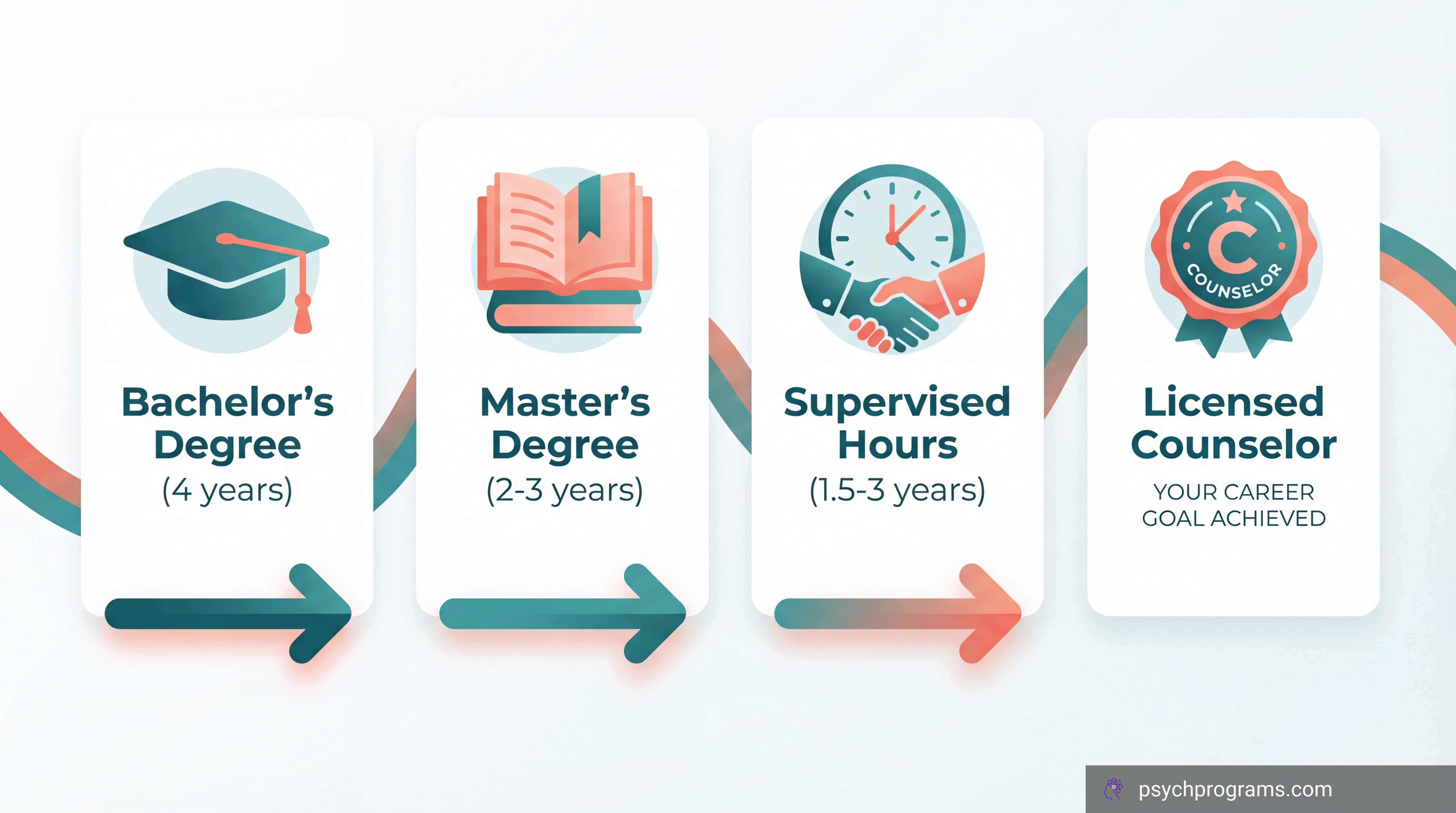
| Stage | Duration | What You're Doing |
|---|---|---|
| Bachelor's Degree | 4 years | Psychology, social work, or related major. Building foundation. |
| Master's Degree | 2-3 years | 60 credit hours of clinical coursework + practicum + internship |
| Supervised Clinical Hours | 1.5-4 years | Working as a provisional/associate counselor under supervision |
| Licensing Exam | 2-6 months | Studying for and passing the NCE or NCMHCE |
| Full Licensure | Ongoing | Independent practice, continuing education requirements |
The biggest variable is your state's supervised hours requirement. In r/therapists, counselors shared their actual timelines. u/monkeylion finished 3,000 hours in about 1.5 years after graduation. u/DrSnarkyTherapist took 3.5 years for 2,000 hours because they were also pursuing a PhD. u/CRLTSUX spent about three years on California's 3,500-hour requirement.
The common thread: if you're working full-time in a clinical role, you can usually finish in 1.5-2.5 years. If you're part-time, splitting between clinical and non-clinical work, or dealing with life events, it stretches to 3-4 years.
Step 1: Get Your Bachelor's Degree
You need a bachelor's degree to get into a master's program. That's non-negotiable for mental health counseling. The specific major matters less than you'd think. Psychology is the most common, but admissions committees accept social work, sociology, human services, education, and even unrelated majors if you've taken the right prerequisite courses.
What those prerequisites usually include:
- Introduction to Psychology
- Abnormal Psychology
- Statistics or Research Methods
- Developmental Psychology
- A few psychology electives (personality theory, social psych, etc.)
If you're still working on your bachelor's, check out our best online bachelor's in psychology programs for accredited options.
One important note: for substance abuse and addiction counseling specifically, about 22 states allow entry-level certification without any degree at all, and another 10 require only an associate's. If addiction counseling is your specific goal, you may not need a bachelor's. But for licensed mental health counseling (LPC, LMHC, LCPC), you absolutely do.
Step 2: Earn Your Master's Degree
This is where the real training starts. You need a master's degree from a program accredited by CACREP (Council for Accreditation of Counseling and Related Educational Programs). CACREP accreditation matters because:
- Florida, Kentucky, and North Carolina require CACREP for licensure
- Graduates of CACREP programs have higher licensing exam pass rates
- Federal and VA counselor jobs often require a CACREP degree
- Most states accept CACREP programs without question; non-CACREP programs sometimes need course-by-course evaluation
CACREP's 2024 standards require a minimum of 60 semester hours, including 100 hours of practicum (40 direct client contact) and 600 hours of internship (240 direct client contact). You'll cover eight foundational areas: professional orientation, diversity, human development, career development, counseling relationships, group work, assessment, and research.
Counseling Specialties: Which One Should You Choose?
CACREP recognizes eight specialty areas. Here's how they compare:
| Specialty | Median Salary | Job Growth | Typical Setting |
|---|---|---|---|
| Clinical Mental Health Counseling | $59,190 | +17% | Private practice, agencies, hospitals |
| School Counseling | $65,140 | +4% | K-12 schools, colleges |
| Marriage & Family Therapy | $63,780 | +13% | Private practice, family agencies |
| Addiction Counseling | $59,190 | +17% | Rehab centers, outpatient clinics |
| Rehabilitation Counseling | $46,110 | +1% | Government agencies, nonprofits |
| Career Counseling | $65,140 | +4% | Universities, workforce agencies |
Source: Bureau of Labor Statistics, May 2024 data. Growth projections 2024-2034.
Clinical mental health counseling is the most versatile choice. It qualifies you for the widest range of licensure types and work settings. School counseling pays slightly more on average and comes with summers off, but locks you into K-12 settings. Marriage and family therapy has strong growth but a smaller job market (77,800 total positions vs. 483,500 for mental health counselors).
What Does a Master's in Counseling Cost?
This is the part most career guides gloss over. A 60-credit master's in counseling costs:
- Public universities: $27,000-$42,000 total ($450-$700/credit)
- Private universities: $42,000-$66,000+ ($700-$1,100/credit)
- High-end programs: Some exceed $100,000 (George Washington University charges roughly $2,000/credit)
Compare our best online counseling programs to find accredited options ranked by value.
For school counseling, costs range from about $7,000/year (University of the Cumberlands) to over $65,000 total. The cheapest route is typically an in-state public university with an online or hybrid format.
Accelerated Counseling Programs
If you want to move faster:
- Accelerated programs compress the master's into 12-18 months of full-time study (heavy course loads, summer terms)
- 4+1 programs let you start master's coursework during your senior year of undergrad, finishing the combined degrees in 5 years instead of 6-7
- Online programs often allow more flexible pacing, with some students finishing in under 2 years
Step 3: Complete Your Supervised Clinical Hours
After graduation, you'll apply for a provisional or associate license (the title varies by state: LPC-A, LPC-IT, LMHC-CC, etc.) and start accumulating supervised clinical hours. This is the part where you're doing essentially the same work as a fully licensed counselor, but under someone else's supervision, and usually for less money.
How Many Hours Does Your State Require?
This is where the "fastest path" question gets real. The difference between states is enormous:
| State | Hours Required | License Title | Notes |
|---|---|---|---|
| Idaho | 1,000 | LPC | Lowest in the country for initial licensure |
| Florida | 1,500 | LMHC | Requires CACREP program |
| South Carolina | 1,500 | LPC | |
| Colorado | 2,000 | LPC | |
| Oregon | 2,400 | LPC | |
| Texas | 3,000 | LPC | Most common requirement nationally |
| California | 3,000 | LPCC | |
| New York | 3,000 | LMHC | |
| Massachusetts | 3,360 | LMHC | Includes 960 direct client contact hours |
| Virginia | 3,400 | LPC | |
| Kentucky | 4,000 | LPCC | |
| New Jersey | 4,500 | LPC | Highest in the nation |
Source: LPC Requirements by State, 2026 data.
In r/therapists, one counselor in Massachusetts explained: "The 3,360 hrs includes separately counted client contact hours (960) and supervision hours (135). But pretty much anything remotely clinical or involved in your clinical job can count to those general hours, if your supervisor is cool with it." That's a critical detail. Not all hours need to be face-to-face therapy. Case notes, treatment planning, clinical consultations, and related tasks count toward the total in most states.
How Much Do Pre-Licensed Counselors Earn?
This is the part nobody tells you about upfront. In r/therapists, u/Worker-Bee-4952 wrote: "I still wish I knew more about the 2 tiered licensing system in most states and how hard and how little you get paid at the bottom level. I remember my master's program saying I would be eligible for licensure when I graduated but didn't tell me I'd struggle to find a job with a living wage that would provide me with supervision."
Another user in the same thread captured the anxiety: "I'm in grad school, making 60k in my not mental health related job, and I'm really nervous that when I get my LPC-IT I won't make as much money. It's so nice to not have to struggle with money right now. I often wonder if this program is worth it because I am terrified of being in poverty again."
Pre-licensed counselors typically earn $35,000-$50,000 depending on setting and location. Community mental health agencies are the most common employers during this phase because they provide built-in supervision. The trade-off is lower pay and higher caseloads. Some counselors pay for private supervision out of pocket ($50-$150 per session), which adds to the financial strain.
Step 4: Pass Your Licensing Exam
Most states require one of two national exams, both administered by the NBCC (National Board for Certified Counselors):
| Exam | NCE | NCMHCE |
|---|---|---|
| Full Name | National Counselor Examination | National Clinical Mental Health Counseling Exam |
| Format | 200 multiple-choice questions | 11 clinical case simulations |
| Time | 4 hours 15 minutes | 4 hours 15 minutes |
| Cost | $275 | $275 |
| First-Time Pass Rate | 83% | 70-77% |
| Tests | General counseling knowledge | Applied clinical decision-making |
| Best For | States requiring general licensure | States requiring clinical-level licensure |
Most states accept either exam, or let you choose. A few (like Florida) specifically require the NCMHCE. Some states also have a state-specific jurisprudence exam covering local laws and ethics. These are usually shorter and easier than the national exam.
Graduates of CACREP-accredited programs consistently have higher pass rates. That's another reason CACREP accreditation matters: it's not just a rubber stamp, it actually prepares you better for the exam.
Step 5: Apply for Full Licensure
Once you've completed your hours and passed your exam, you submit your application to your state licensing board. This involves:
- Application fee ($100-$300 depending on state)
- Verification of your supervised hours from your supervisor(s)
- Official transcripts from your master's program
- Exam score verification
- Background check
Processing times vary from a few weeks to several months depending on the state and current backlog. Plan for 1-3 months.
The Counseling Compact: Practice Across State Lines
A major development: 39 states plus DC have now enacted the Counseling Compact, which allows licensed counselors to practice across participating state lines without getting a separate license in each state. As of early 2026, Arizona, Minnesota, and Ohio are fully operational, with dozens more states completing implementation.
This is a game-changer for telehealth counselors and anyone who lives near a state border. It also means that choosing your initial licensing state is becoming less of a permanent decision than it used to be.
What License Title Will You Have?
One of the most confusing things about counseling licensure is that every state calls it something different. You're doing the same work, but the letters after your name depend on where you live:
| Title | States |
|---|---|
| LPC (Licensed Professional Counselor) | Used in the majority of states: TX, GA, NC, VA, PA, OH, CO, and 25+ more |
| LMHC (Licensed Mental Health Counselor) | FL, IN, NY, WA, HI, IA |
| LCPC (Licensed Clinical Professional Counselor) | IL, MD, MT, NV, ID, KS, ME |
| LPCC (Licensed Professional Clinical Counselor) | CA, KY, MN, NM, OH |
| LCMHC (Licensed Clinical Mental Health Counselor) | NH, RI, UT, VT |
They're all functionally equivalent. An LPC in Texas does the same work as an LMHC in Florida or an LCPC in Illinois. The different titles exist because each state wrote its own licensing law independently.
LPC vs LCSW: Should You Do Counseling or Social Work?
This is one of the most common questions prospective counselors ask, and it came up constantly in our research. We have a full comparison of LCSW vs LPC, but here's the short version:
In r/therapists, when asked about degree regret, u/Big_Kick_5760 (97 upvotes) wrote: "I am currently wishing I had pursued a social work degree. When I chose the LPC track I did so under so much confidence all I wanted to do was provide individual therapy. Three years in and I've done a 180 wishing I could have a case management/indirect care heavy job but most positions in my area want LCSWs."
But u/RadMax468 (35 upvotes) offered the counter: "A large factor in the traditional MSW-LPC gap has been the fact that Medicare wouldn't cover LPC services. That ends this coming Jan when mental health counselors become Medicare providers. So if your focus is primarily clinical, the LPC is better therapy training/prep, and LPC will be more in demand very soon."
The takeaway: if you know you want to do therapy and only therapy, the counseling path gives you more clinical training during your degree. If you want maximum career flexibility (case management, hospital social work, policy, administration, plus therapy), the MSW gives you more options. Browse our best online MSW programs if social work sounds like a better fit.
How Much Do Counselors Make?
Counselor salaries depend heavily on your specialty, setting, licensure level, and whether you're in private practice:
| Specialty | Median | 10th %ile | 90th %ile | Annual Openings |
|---|---|---|---|---|
| School & Career Counselors | $65,140 | $43,580 | $105,870 | ~31,000 |
| Marriage & Family Therapists | $63,780 | $42,610 | $111,610 | ~7,700 |
| Mental Health Counselors | $59,190 | $39,090 | $98,210 | ~48,300 |
| Rehabilitation Counselors | $46,110 | $34,480 | $77,200 | ~10,000 |
Source: Bureau of Labor Statistics, May 2024 data.
These medians tell only part of the story. Private practice counselors with full caseloads and insurance paneling typically earn $80,000-$120,000+. Some earn well above that. But building a private practice takes time. Most counselors spend their first few years in agency settings gaining experience and completing their supervised hours before transitioning to private practice.
For detailed salary breakdowns by state, experience, and employer type, see our counselor salary guide.
What to Know Before Becoming a Counselor
We pulled insights from practicing counselors in r/therapists. Here's what they said about getting into the field:
u/SoleIbis (80 upvotes): "It's a lot more emotionally taxing than you think. You need to have your own ducks in a row before you can effectively help others, otherwise you will be stuck in a loop."
u/muscravageur (62 upvotes): "Beyond 'don't kill yourself,' therapists never give advice. We work in the client's world with the client's strengths to change their lives in the ways they want. The therapist's struggle is to take themselves out of the therapy."
u/lotusgrowinthemud (46 upvotes): "Techniques, theories etc are nice but what really matters is the rapport and relationship between you and your client. That's where the healing is."
u/thestarlightcrystal (31 upvotes): "I wish I had known that doing my personal inner work would have the biggest impact on my work with clients. All the trainings and certifications I have and yet it's been working through my own issues around trust and reckoning with this human experience that has allowed me to be truly open and loving with my clients."
The consistent message across dozens of comments: get your own therapist before you try to be one for other people. The clinical skills matter, but your own self-awareness and emotional regulation matter more.
The Fastest Possible Path to Counselor Licensure
If speed is your priority, here's how to minimize the timeline:
- Choose a low-hours state. Idaho (1,000 hours), Florida (1,500), or South Carolina (1,500) cut 1-2 years off your post-graduation timeline compared to states like New Jersey (4,500) or Kentucky (4,000).
- Enroll in an accelerated CACREP program. Some programs compress the 60-credit master's into 12-18 months of intensive full-time study.
- Maximize practicum/internship hours. Some states let you count hours earned during your master's program toward your post-graduation supervision requirement. Check your state board's rules before enrolling.
- Work full-time in a clinical role immediately after graduation. A full-time clinical position (30-40 client-facing hours per week) accumulates hours much faster than part-time or split roles.
- Take your exam while still in your program or immediately after. Don't let months pass between graduation and exam prep. The material is freshest right after your coursework.
Following this approach, the absolute fastest realistic timeline is about 6.5-7 years from starting your bachelor's to full licensure: 4 years bachelor's + 1.5 years accelerated master's + 1-1.5 years supervised hours in a low-requirement state.
Should You Become a Counselor?
Be honest with yourself about a few things before committing:
The training is long. You're looking at 7-10 years from the start of undergrad to independent licensure. That's a significant time investment, and the pre-licensure period where you're earning less than your education suggests you should is genuinely difficult.
The early career pay is rough. Pre-licensed counselors earn $35,000-$50,000 while carrying $30,000-$60,000+ in student loan debt. The financial math doesn't work out for several years. You need to plan for that gap.
The work is emotionally heavy. You'll sit with people in their worst moments. You'll hear about trauma, abuse, suicidal thoughts, and grief on a daily basis. Compassion fatigue and burnout are occupational hazards, not personal failings. Having your own therapist isn't optional; it's a professional necessity.
But the career trajectory is strong. 17% job growth for mental health counselors means demand is real and increasing. The post-pandemic mental health surge hasn't slowed down. Telehealth has expanded access and created new practice models. Medicare coverage for LPCs (starting 2025) opens up an entirely new patient population and revenue stream. And private practice, once you get there, offers $80,000-$120,000+ with genuine work-life balance and autonomy.
Most licensed counselors say it was worth it. The road to get there is just longer and harder than anyone tells you upfront.
Counselor Career FAQ
Can I become a counselor with just a bachelor's degree?
For licensed mental health counseling (LPC, LMHC, etc.), no. Every state requires a master's degree. For substance abuse and addiction counseling, some states allow entry-level certification with a bachelor's or even less. Check your state's addiction counselor certification requirements.
What's the difference between a counselor and a therapist?
In practice, very little. "Counselor" and "therapist" are used interchangeably in most clinical settings. The license determines your scope of practice, not the title. An LPC, LMHC, LCSW, and LMFT can all provide psychotherapy. "Therapist" is an umbrella term; "counselor" usually refers to someone with an LPC or LMHC specifically.
Is a counseling degree worth the debt?
It depends on your financial plan. If you attend an affordable public program ($27,000-$42,000) and move into full-time clinical work immediately after graduation, the ROI is reasonable within 5-7 years. If you take on $80,000+ in debt for a private program and then work part-time during your supervision period, the math gets much harder. Minimize debt as much as possible.
Which state is the easiest to get licensed in?
Idaho has the lowest supervised hours requirement at 1,000 for LPC. Florida (1,500) and South Carolina (1,500) are also relatively fast, though Florida requires a CACREP-accredited program specifically. Keep in mind that "easiest" and "best for your career" aren't always the same thing. Choose a state where you actually want to work.
Can I practice across state lines with a counseling license?
The Counseling Compact is making this possible. Thirty-nine states plus DC have enacted the compact, with Arizona, Minnesota, and Ohio currently operational. Once your state is active in the compact, you can provide services to clients in other participating states without a separate license.
How do I choose between LPC and LCSW?
If you want maximum clinical training during your degree and plan to do therapy as your primary career, the LPC path (master's in counseling) is the stronger clinical preparation. If you want broader career flexibility (therapy plus case management, hospital social work, policy, administration), the LCSW path (MSW) keeps more doors open. Read our full LCSW vs LPC comparison.
Compare Accredited Counseling Programs
Ready to take the next step? Start by comparing accredited programs:
- Best Online Counseling Programs (CACREP-accredited clinical mental health counseling)
- Best Online MSW Programs (if the social work path appeals to you)
- Best Online Master's in Psychology Programs (for non-clinical psychology careers)
- Best Online Bachelor's in Psychology Programs (if you still need your undergrad)
Or explore related career paths:
Explore Psychology Programs
Ready to take the next step? Browse our expert-ranked program listings.