What Can You Do With a Psychology Degree? Careers at Every Level
Psychology is the 5th most popular bachelor's degree in America. About 130,000 people graduate with one every year. Here's what they actually end up doing, what it pays, and how to make the degree work for you.


About 130,000 people earn a psychology degree every year. That makes it the 5th most popular bachelor's degree in the country, right behind engineering and ahead of communications, education, and business combined in several subcategories.
And yet, if you spend any time talking to recent grads, you'll hear a very different story. "Useless." "I wish I'd picked something else." "You need a master's to do anything."
The truth is somewhere in the middle. A psychology degree isn't useless. But it isn't a career ticket either. It's more like a Swiss Army knife: useful in a surprising number of situations, but only if you know which tool to pull out.
This guide breaks down every realistic career path for psychology graduates, from entry-level bachelor's jobs to doctoral-level specializations. No fluff. Real salary data. And honest talk about what the job market actually looks like.
Psychology Degree Job Market: What the Data Shows
Before we get into specific careers, you need to understand the landscape.
According to APA data, roughly 57% of psychology bachelor's holders enter the workforce directly and never go to graduate school. About 25% pursue graduate degrees in psychology, and another 18% get graduate degrees in other fields like education, social work, business, or law.
That 57% number is important. The majority of people with a psychology degree work outside of psychology. And many of them are doing just fine, because the skills you build in a psych program (research methods, data analysis, understanding human behavior, clear writing) transfer to a lot of fields.
But there's a catch. In r/careerguidance, a thread with over 380 comments on whether a psych bachelor's is "worthless" surfaced a consistent theme: the degree doesn't open doors by itself. You have to pair it with a plan.
As one commenter in r/psychologystudents put it bluntly: "It's not useless. You just didn't plan ahead." That post got over 1,000 upvotes because it struck a nerve. Another user shared their experience: "I went into psychology with a plan. I was going to start in case management for 1-2 years. By the time I graduated, the jobs dried up, employers became so much more picky demanding college graduates to materialize years of experience out of thin air."
So where does that leave you? With the need for a clear-eyed view of what each career path actually looks like.
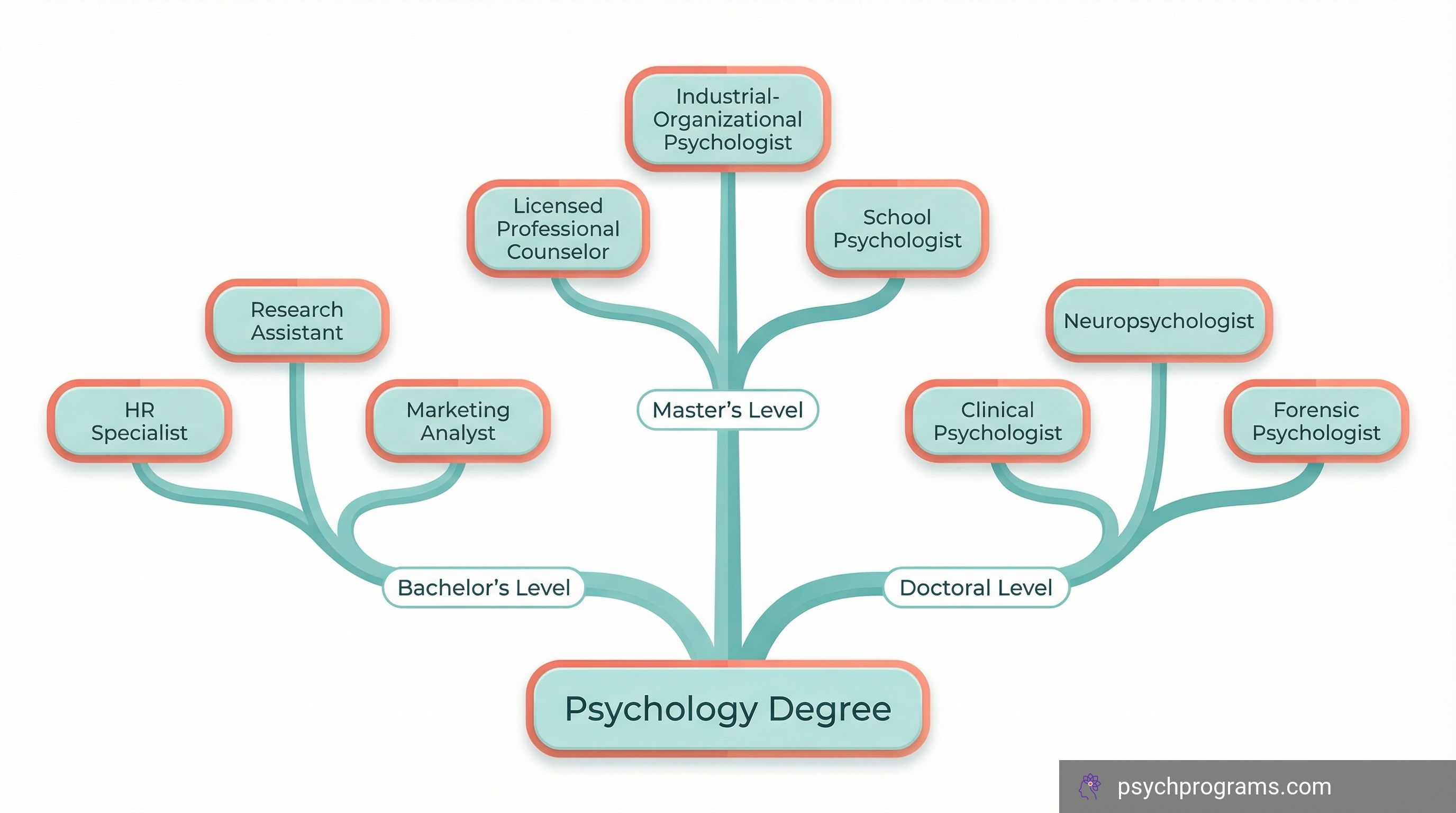
Careers With a Bachelor's in Psychology
You won't be a therapist. You won't be a psychologist. You won't diagnose anyone. Every state requires at least a master's degree for clinical work, and most require a doctorate. But a bachelor's in psychology qualifies you for more jobs than you probably think. The key is understanding which ones value psych-specific skills versus which ones just need any bachelor's degree.
| Career | Median Salary | Job Growth | Why Psych Grads Fit |
|---|---|---|---|
| Market Research Analyst | $76,950 | +7% | Survey design, data analysis, consumer behavior |
| Social/Community Service Manager | $78,240 | +6% | Program management, advocacy, case oversight |
| Human Resources Specialist | $72,910 | +6% | Group dynamics, motivation, conflict resolution |
| Probation Officer | $64,520 | +3% | Risk assessment, behavioral intervention |
| Psychiatric Technician | $42,590 | +16% | Direct patient care, treatment plans, crisis mgmt |
| Research Assistant | ~$42,000 | Varies | Study design, data collection, academic writing |
| Case Manager | ~$39,930 | +8% | Client assessment, resource navigation |
Source: Bureau of Labor Statistics, May 2024 data. Growth projections are for 2024-2034. National average growth is 3%.
Human Resources Specialist
This is one of the most natural fits for psych grads, and it pays better than most people expect. HR specialists handle recruiting, onboarding, employee relations, benefits administration, and workplace conflict. Everything you studied about human behavior, group dynamics, and motivation applies directly.
The BLS reports a median salary of $72,910 for HR specialists, with 6% projected growth through 2034. Entry-level roles start lower, typically $45,000-$55,000, but you can move up quickly, especially if you pick up a PHR (Professional in Human Resources) certification.
If you want to go deeper, people analytics is a growing subfield where psych grads have a real edge. Companies like Google, Microsoft, and Meta have entire teams dedicated to using behavioral data to improve hiring, retention, and employee experience. These roles combine your psychology background with data skills and pay well into six figures.
Market Research Analyst
If you enjoyed the research methods courses in your psych program (survey design, data analysis, hypothesis testing), market research is a natural pivot. You're doing the same thing, just applied to consumer behavior instead of clinical populations.
Market research analysts earn a median of $76,950 with 7% growth. About 87,200 openings are projected per year. The work involves designing surveys, running focus groups, analyzing purchase data, and translating findings into business strategy. If you took statistics and research methods seriously in your psych program, you already have the foundational skills.
Research Assistant or Lab Coordinator
This is the most common stepping stone for psych grads who want to eventually go to grad school. You'll work in a university or private research lab, helping run studies, collect data, recruit participants, and manage lab operations.
The pay is low. In r/psychologystudents, one research assistant shared: "Full-time research assistant for a private university. Pay is pretty low ($20/hr) but pays for part of my tuition as I'm currently in a MA in Counseling program." That's roughly $40,000-$45,000 a year full-time. But the real value is the experience, the letters of recommendation, and the research publications that get you into competitive grad programs.
If you're aiming for a PhD program in clinical, cognitive, or developmental psychology, 1-2 years as an RA is almost a prerequisite at this point. Programs want to see that you can do the work before they invest 5-7 years of funding in you.
Psychiatric Technician
If you want to work directly with people who have mental health conditions but aren't ready (or don't want) to commit to graduate school, psychiatric tech roles are one of the few clinical-adjacent positions open at the bachelor's level.
Psych techs work in inpatient psychiatric hospitals, residential treatment centers, and crisis stabilization units. You'll monitor patients, help implement treatment plans, lead group activities, and manage behavioral crises. It is emotionally demanding work. The BLS median is $42,590, but the field is growing at 16%, which is much faster than average.
Be honest with yourself about whether you can handle it. You'll see people at their worst. But if you want hands-on clinical exposure, this is one of the most direct paths with just a bachelor's.
Case Manager / Social Services Coordinator
Case managers connect people with resources: housing, mental health treatment, substance abuse programs, job training, benefits. You're the person who figures out what a client needs and then navigates the system to get it for them.
This is where a lot of the frustration centers. The work is meaningful but the pay is rough. Entry-level case management positions typically pay $35,000-$42,000. Social and human service assistants earn a BLS median of $39,930. You'll have a heavy caseload, extensive documentation requirements, and emotional burnout is common.
That said, case management experience is extremely valuable if you plan to get an MSW or counseling degree. Clinical programs want applicants who've actually worked with vulnerable populations, not just read about them.
Probation Officer
If you took forensic or criminal psychology courses, this is one of the more accessible career paths. Probation officers supervise people who've been convicted of crimes and released into the community. You assess risk, enforce court conditions, connect people with services, and decide when someone is violating the terms of their release.
The BLS median is $64,520 with roughly 7,900 openings projected per year. Growth is 3%, which is average. Many agencies require a bachelor's in psychology, criminal justice, or social work. The work is high-stakes and sometimes dangerous, but probation officers have more autonomy and decision-making authority than most bachelor's-level social service roles.
Registered Behavior Technician (RBT)
This one flies under the radar for a lot of psych majors, but the applied behavior analysis (ABA) field is booming. RBTs work directly with children and adults, usually with autism spectrum disorder, implementing behavior intervention plans designed by a BCBA.
You only need 40 hours of training and a certification exam to become an RBT. A bachelor's in psychology isn't even required, but it gives you a strong foundation and makes you more competitive. Starting pay is typically $18-$25/hour ($37,000-$52,000), depending on your location and setting.
The ABA field has 17% projected growth for behavioral disorder counselors and related roles. If you decide to pursue a master's in ABA and become a BCBA, salaries jump to $70,000-$95,000+. Check our best online ABA programs if that path interests you.
UX Researcher
User experience research is where psychology meets tech, and it pays extremely well compared to most bachelor's-level options. UX researchers study how people interact with software, websites, and products. You design usability studies, run interviews, analyze behavior patterns, and deliver findings that shape product decisions.
The catch: most UX research roles prefer a master's degree, and competition is intense. But junior UX research positions and UX research assistant roles do exist at the bachelor's level, especially at agencies and mid-size tech companies. In r/psychologystudents, one user noted: "There are fields like user experience research that pay well and hire people with psychology degrees, but those jobs typically require advanced degrees since you are expected to be able to already know how to design and run research studies independently."
If you're interested in this path, build a portfolio during undergrad. Run your own usability studies. Learn tools like UserTesting, Maze, or Optimal Workshop. Entry-level UX research roles pay $55,000-$70,000, with senior researchers earning well into six figures at major tech companies.
Recruiting and Talent Acquisition
Recruiters assess candidates, conduct interviews, evaluate cultural fit, and negotiate offers. Your psych training in interviewing, interpersonal dynamics, and bias recognition gives you a genuine advantage over the average person who falls into recruiting.
Agency recruiting can start at $40,000-$50,000 base but with commission structures that push total comp to $60,000-$80,000+ in your first few years. Corporate talent acquisition roles pay $55,000-$75,000 at the entry level. And unlike many social service roles, there's a clear upward trajectory into talent acquisition management, people operations, or HR leadership.
Careers With a Master's in Psychology or Related Field
If you look at the BLS data, something becomes very clear very fast: the salary jump between bachelor's-level and master's-level roles in psychology is enormous. We're talking $40,000-$50,000 jobs versus $60,000-$80,000+ jobs. A master's degree is the inflection point where psychology stops being "that interesting thing I studied" and becomes "my profession."
| Career | Median Salary | Job Growth | Program Type |
|---|---|---|---|
| I-O Psychologist | $109,840 | +6% | MA/MS in I-O Psychology |
| BCBA | $65,000-$95,000+ | +17% | MS in ABA |
| Marriage & Family Therapist | $63,780 | +13% | MS in MFT |
| School Counselor | $61,710 | +5% | MS in School Counseling |
| Licensed Counselor (LPC) | $59,190 | +17% | MS in Counseling |
| Licensed Clinical Social Worker | $61,330 | +7% | MSW |
Source: Bureau of Labor Statistics, May 2024 data. Private practice counselors and LCSWs often earn $80,000-$120,000+.
Licensed Professional Counselor (LPC) or Licensed Clinical Social Worker (LCSW)
These are the two most common paths into clinical therapy work. Both require a master's degree (in counseling or social work, respectively), 2-3 years of supervised clinical hours, and passing a licensing exam. We've written a detailed LCSW vs LPC comparison if you're trying to decide between the two.
The BLS median for mental health counselors is $59,190. Counselors in private practice earn $80,000-$120,000+ depending on caseload, specialty, and market. Job growth is projected at 17% through 2034, which is one of the fastest growth rates in all of healthcare. Browse top-ranked online counseling programs or online MSW programs to compare your options.
School Counselor
School counselors work in K-12 settings helping students with academic planning, social-emotional development, and college/career readiness. You'll need a master's in school counseling and state licensure.
The pay is tied to teacher salary schedules in most districts, so it varies wildly by state. Median is around $61,710 nationally. Summers off is a real perk. The school psychologist role is similar but requires a specialist-level degree (Ed.S.) and focuses more on testing and evaluation.
Industrial-Organizational (I-O) Psychologist
I-O psychology is the highest-paying psychology specialty you can enter with a master's degree. I-O psychologists apply psychological principles to workplace problems: employee selection, training design, organizational culture, performance management, leadership development.
The BLS reports a median of $109,840 for I-O psychologists. Some master's-level I-O professionals work under titles like "people analytics manager," "organizational development consultant," or "talent strategy director" at salaries well above that. This is the psych specialty where you're most likely to earn six figures without a doctorate. See our full I-O psychologist career guide for more.
Marriage and Family Therapist
MFTs specialize in relationship dynamics, family systems, and couples therapy. You'll need a master's in marriage and family therapy from a COAMFTE-accredited program and about 2 years of supervised practice. The BLS median is $63,780, with 13% growth projected through 2034.
Board Certified Behavior Analyst (BCBA)
If you started as an RBT (described above), the BCBA is the next level. It requires a master's degree with specific ABA coursework, 1,500-2,000 supervised fieldwork hours, and passing the BCBA exam. BCBAs design and oversee behavior intervention programs, primarily for individuals with autism.
The BCBA salary ranges from $65,000 to $95,000+ depending on setting and location. Demand is extremely high, with the BCBA career path being one of the fastest-growing in the behavioral health space. Compare top online ABA programs if you're considering this route.
Careers With a Doctorate in Psychology
A doctorate takes 4-7 years after your bachelor's (PhD) or 4-6 years (PsyD). It's a massive investment of time and money. PsyD programs can cost $100,000-$250,000 in tuition. PhD programs are usually funded (tuition waiver plus a stipend), but the stipend is modest ($20,000-$30,000/year) and you're trading years of potential earnings.
Is it worth it? For the right person, yes. The BLS median for psychologists is $94,310, with the top 10% earning over $157,330. But you have to know what you're going into.

Clinical Psychologist
Clinical psychologists assess, diagnose, and treat mental health disorders. Most work in private practice, hospitals, or community mental health centers. You'll need a doctorate (PhD or PsyD), a year-long predoctoral internship matched through the APPIC system, and 1-2 years of postdoctoral supervised practice before you can get licensed.
The clinical psychologist path is the most common doctoral route. Salaries vary enormously by setting: VA hospitals and federal agencies pay well ($90,000-$130,000), private practice income depends on your caseload and insurance panels, and community mental health pays the least. Compare top PsyD programs if you're considering this path.
Neuropsychologist
Neuropsychologists specialize in brain-behavior relationships. You'll spend most of your time conducting cognitive and neurological assessments for patients with brain injuries, dementia, stroke, ADHD, and learning disabilities. This is one of the more specialized and higher-paying psychology careers. See our neuropsychologist career guide for the full breakdown.
Forensic Psychologist
Forensic psychologists work at the intersection of psychology and the legal system. You might evaluate defendants' competency to stand trial, assess risk for violence, provide expert testimony, or work with law enforcement on criminal profiling (though the TV version is wildly exaggerated). Check our forensic psychologist guide for what the career actually looks like.
School Psychologist (Doctoral Level)
While you can practice school psychology with a specialist-level degree (Ed.S.), a doctorate opens doors to leadership roles, private practice, and higher salaries. Doctoral-level school psychologists conduct complex psychoeducational evaluations, consult with districts on policy, and supervise other practitioners.
Alternative Careers With a Psychology Degree
These are roles where a psychology background gives you a genuine competitive advantage, but they don't show up in "careers for psychology majors" articles because they don't have "psychologist" in the title.
Behavioral Design and Nudge Consulting
Companies like ideas42, the Behavioural Insights Team, and Deloitte's behavioral economics practice hire people who understand cognitive biases, decision-making heuristics, and behavior change. This is applied psychology in a business context. The work involves designing "nudges" that help people make better financial, health, or environmental decisions. Salaries range from $60,000 at entry level to $120,000+ for senior consultants.
People Analytics
Companies like Google, Microsoft, and Salesforce have entire departments dedicated to using data to understand employee behavior. People analytics combines psychology with data science. If you pair your psych degree with SQL, R, or Python skills, you're a strong candidate. These roles start at $70,000-$90,000 and scale well into six figures.
DEI (Diversity, Equity, and Inclusion)
Understanding bias, intergroup dynamics, cultural psychology, and organizational behavior positions psych grads well for DEI roles. These positions exist in most Fortune 500 companies, universities, and large nonprofits. Pay ranges from $55,000 at entry level to $120,000+ for directors.
Psychometrics and Assessment Design
If you loved psychological testing and measurement courses, assessment companies need people who understand test design, reliability, validity, and item analysis. EdTech companies, standardized testing organizations (ETS, Pearson, ACT), and HR assessment firms all hire for these roles. A master's helps, but some entry-level positions are open to bachelor's holders with strong stats backgrounds.
What Jobs Do Psychology Graduates Actually Get?
Data and salary medians only tell part of the story. Here's what actual psychology graduates reported when asked "What jobs do you hold with your degree?" in r/psychologystudents:
- Psychometrist for a neuropsychologist: "Good money, great experience." (Though another user cautioned there was only one open position in their entire state.)
- Data and research associate at an education nonprofit: "$54,000-$56,000 per year. I really enjoy my job."
- Research assistant at a private university: "$20/hr but pays for part of my tuition."
- Support worker with adults and children: "The work can be fulfilling if your management is caring, although most support work positions are mentally taxing."
- Bartender: "Because I make more money." (This one got 66 upvotes.)
That range is the honest reality. Some psych grads land great roles that use their training. Others struggle to find anything that pays a living wage. The difference almost always comes down to whether they built experience and skills during undergrad or waited until after graduation to figure it out.
BA vs BS in Psychology: Does It Matter?
About 80% of psychology bachelor's degrees go to women, and programs offer both BA (Bachelor of Arts) and BS (Bachelor of Science) options. The short answer: for most career paths, it doesn't matter much.
The longer answer: BS programs typically require more natural science coursework (biology, chemistry, physics) and heavier statistics and research methods training. BA programs allow more elective flexibility and often pair well with minors in business, sociology, or communications.
If you're aiming for research-heavy careers (lab coordinator, UX research, people analytics, grad school in experimental or cognitive psychology), the BS gives you a slight edge because of the stronger quantitative foundation. If you're heading toward HR, social services, counseling prep, or business roles, the BA is perfectly fine.
Grad schools don't care. They look at your GPA, research experience, GRE scores (if required), and letters of recommendation. Nobody has ever been rejected from a doctoral program because they had a BA instead of a BS.
How to Make Your Psychology Degree Worth It
The single biggest predictor of whether you'll say "my degree was worthless" or "my degree opened doors" is what you do during undergrad, not after. Based on the BLS data, hiring trends, and hundreds of firsthand accounts from graduates, these are the moves that matter:
Get research experience early
Join a lab by sophomore year. Don't wait to be invited. Email professors, show up to office hours, ask to volunteer. Research experience is the currency of psychology. It gets you into grad school, qualifies you for research assistant jobs, and teaches you skills (data analysis, study design, academic writing) that transfer to market research, UX, and analytics roles.
Do at least one relevant internship
An internship in HR, a mental health agency, a research lab, or a behavioral health company gives you work experience that separates you from every other new grad with the same degree and no experience. One user in r/psychologystudents summed up the problem: "Employers became so much more picky demanding college graduates to materialize years of experience out of thin air."
Internships solve that problem. Your university's career center can help you find them. Practicum courses that include field placements are even better.
Pick up a practical certification
Certifications signal to employers that you can do something specific, not just that you studied a topic. Strong options for psych grads:
- PHR (Professional in Human Resources) for HR career paths
- RBT (Registered Behavior Technician) for ABA/behavioral health
- Google Analytics / Google Data Analytics Certificate for market research and UX paths
- QPR or Mental Health First Aid for social service and case management roles
Learn one data tool
SPSS is standard in psych programs, but the working world runs on Excel, R, Python, SQL, and Tableau. Pick one and get comfortable with it. This single skill separates you from 90% of other psych grads competing for the same positions. Free resources like Google's data analytics certificate, Coursera's R programming course, or DataCamp can get you there in a few months.
Psychology Degree FAQ
Is a psychology degree useless?
No. But it's not a professional degree like nursing or engineering where you graduate directly into a licensed career. About 130,000 people earn one every year, which means the job market is competitive. The graduates who do well are the ones who pair their degree with internships, research experience, or practical certifications. The ones who struggle are the ones who expected the degree to do the work for them.
What is the highest-paying job you can get with a psychology bachelor's?
Market research analyst ($76,950 median) and HR specialist ($72,910 median) are the highest-paying common roles accessible with a bachelor's in psychology. Social and community service managers earn even more ($78,240 median), though those roles often require several years of experience. If you move into tech-adjacent roles like UX research or people analytics, salaries climb further, but those positions are competitive and often prefer a master's.
Do you need a master's degree to work in psychology?
To do clinical work (therapy, assessment, diagnosis), yes. Every state requires at least a master's for clinical licensure, and most psychologist positions require a doctorate. But "working in psychology" is broader than clinical work. Research assistants, psychiatric technicians, behavioral health technicians, and ABA therapists all work in the field with a bachelor's. And many psychology graduates apply their training in non-clinical settings like HR, market research, education, and consulting.
Should I get a BA or BS in psychology?
For most career paths, it doesn't matter. BS programs have more science and statistics requirements, which gives a slight edge for research-focused careers. BA programs offer more flexibility for double majors or minors. Graduate schools don't differentiate between the two when evaluating applicants.
What percentage of psychology majors go to grad school?
According to APA data, about 25% pursue graduate degrees in psychology and another 18% get graduate degrees in other fields. That means roughly 43% of psych majors eventually earn a graduate degree of some kind, which is significantly higher than the 35% average for all bachelor's degree holders.
Is it too late to change careers if I already have a psychology degree?
No. A psychology degree is a bachelor's degree, and most employers hiring for business, nonprofit, government, and tech roles require "a bachelor's degree" without specifying the field. Your psych training in research, data analysis, writing, and human behavior is a genuine asset for careers in HR, marketing, consulting, education, and dozens of other fields. The degree doesn't lock you in or out of anything.
What are the fastest-growing careers for psychology graduates?
Substance abuse and mental health counselors (17% growth), psychiatric technicians (16% growth), and marriage and family therapists (13% growth) are all growing much faster than the national average of 3%. Market research analyst (7%) and HR specialist (6%) round out the bachelor's-level options with above-average growth.
Psychology Programs and Career Paths to Explore
If you're ready to take the next step, start by comparing accredited programs that match your goals:
- Best Online Bachelor's in Psychology Programs (if you're still working on your undergrad)
- Best Online Master's in Psychology Programs (for graduate-level career paths)
- Best Online Counseling Programs (if you want to become a licensed therapist)
- Best Online PsyD Programs (for doctoral-level clinical work)
- Best Online ABA Programs (for the BCBA/behavior analysis path)
- Best Online MSW Programs (if social work is a better fit than counseling)
Or explore specific careers in depth:
Explore Psychology Programs
Ready to take the next step? Browse our expert-ranked program listings.